The Queen Color Code in Beekeeping


In a hive containing between 10,000 and 60,000 bees, spotting the queen often requires patience. A simple colored dot on her thorax changes everything: you can spot her at a glance. However, this mark serves a purpose beyond mere identification—the color follows an international code linked to the queen's birth year.
The purpose of marking
Marking the queen primarily saves time: less time spent searching for her means more time to observe egg-laying, check food stores, or anticipate swarming. It also allows you to determine her age at a glance, which helps in planning when to replace her. Finally, if you ever find a queen whose color does not match the expected year, it indicates "silent supersedure"—meaning the colony has replaced its queen without your intervention.
The international color code
The marking system follows a five-year cycle based on the last digit of the birth year. This system is standardized worldwide; beekeepers in France, Canada, and Australia all use the same colors.
Color chart by year
| Color chart by year | Color | Example years |
| 0 or 5 | 🔵 BLUE | 2020, 2025, 2030 |
| 1 or 6 | ⚪ WHITE | 2021, 2026, 2031 |
| 2 or 7 | 🟡 YELLOW | 2022, 2027, 2032 |
| 3 or 8 | 🔴 RED | 2023, 2028, 2033 |
| 4 or 9 | 🟢 GREEN | 2024, 2029, 2034 |
In 2026, the official color is white.
How to mark a queen
You will need a suitable marker (water-based Posca pens or specialized paint like ICKO work well), a marking cage or mesh to hold her still without injury, and a way to record the date—such as a notebook or the HexaBees app.
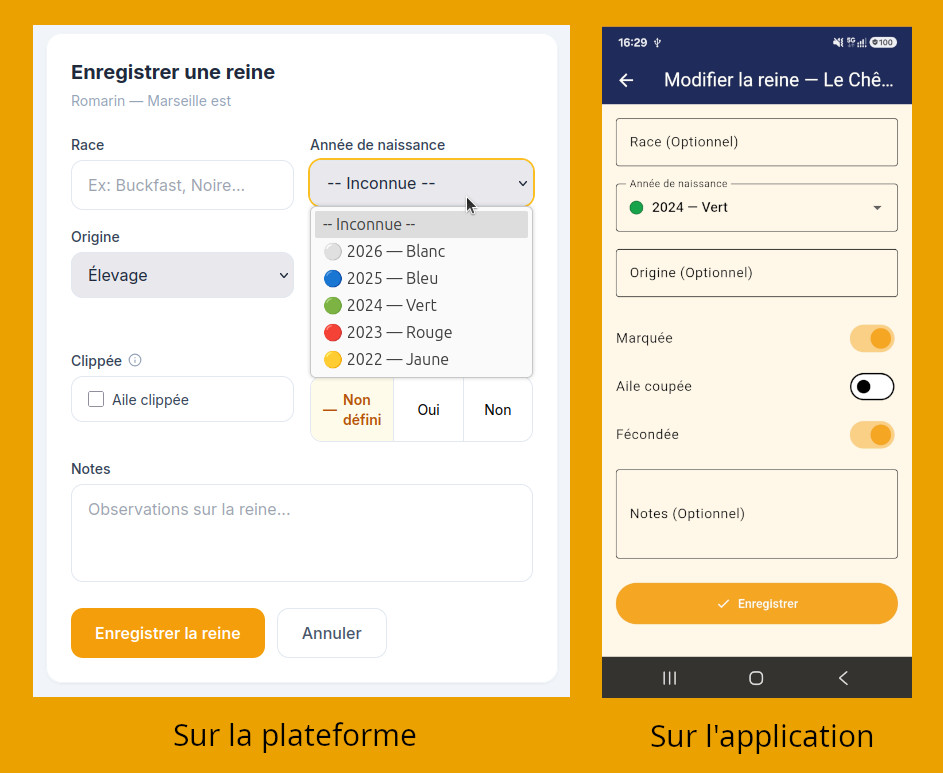
Look for the queen on the brood frames, where she spends most of her time; worker bees often form a ring around her. Restrain her using the marking cage, or gently pick her up between your thumb and forefinger, avoiding her wings. Apply a dot only to the thorax—never the abdomen or wings—to avoid hindering or injuring her. For the color white (used in 2026), adding a thin dark outline improves visibility. Let the mark dry for a few seconds, then gently place her back on a frame rather than on the hive floor, where she could be trampled.
One final tip: avoid marking queens during bad weather when the bees are more agitated, and if you are a beginner, practice handling worker bees first.
Want to keep track of the age and color of each of your queens? HexaBees does it for you, hive by hive.
Rejoignez la conversation
Pour commenter, connectez-vous ou créez un compte gratuit. Les commentaires anonymes ne sont pas autorisés.